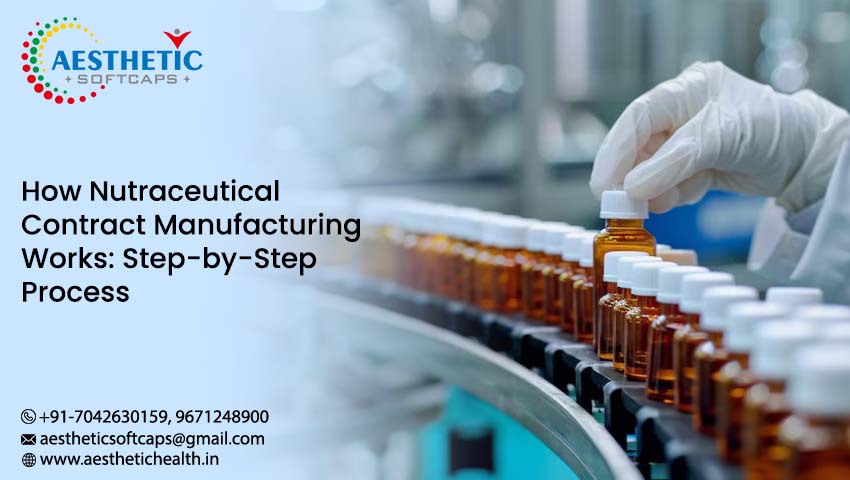
How Nutraceutical Contract Manufacturing Works?: Step-by-Step Process
As nutraceuticals surge in popularity within the health and wellness industry, there is an increasing demand for functional foods and dietary supplements. However, some brands lack the knowledge or infrastructure needed to produce items in-house. This is where Nutraceutical Contract Manufacturing steps in, it provides a simple, affordable solution for businesses that want to market their products without taking care of production.
So as a startup planning to launch a new line of supplements or an established brand wanting to diversify your product offering, note that this guide on nutraceutical contract manufacturing is intended for you.
Understanding Nutraceutical Contract Manufacturing
This is a business model in which a brand sells its supplements by outsourcing production to a contract manufacturer. Under this model, the brand is free to strategize on marketing, sales and distribution while the manufacturer takes care of formulation, sourcing, production, packaging and even regulatory compliance.
With this model, companies that want to minimize the costs of production facilities or regulatory certification are able to quickly and efficiently launch products.
Nutraceutical Contract Manufacturing: Step-by-Step Guide
1. Initial Meeting and Gathering Assignments: To develop a product with a brand, a contract manufacturer has to be approached first. This meeting should cover the following points:
• Product type (capsules, powders, tablets, gummies, etc.).
• Target ingredients and dosage.
• Intended health benefits (e.g., weight loss, immunity, digestion).
• Regulatory preferences (FSSAI, GMP, FDA, etc.).
The manufacturer can also help refine product ideas which can assist with market demands and practicality.
2. Creating A Formulation: Based on the learning up to this point, the prerequisites have been clearly laid out, therefore the product can be formulated now based on science, as the manufacturer’s R&D team has already done. This step includes the following:
• Selecting active ingredients and excipients.
• Ensuring proper bioavailability and stability.
• Conducting lab trials to check compatibility and performance.
3. Final Agreement and Quotation Compilation: Inbound and sharing the formulation gets us to the final confirmation stage which allows creation of the following rule document:
• Price for each estimated unit – based on the production schedule.
• Estimation for lead time along with the delivery schedule.
• Packaging option with the estimated cost and the MOQ.
• Confirmed Pricing for every unit.
4. Sourcing of Materials and Their Packaging: Following the signing of the contract, the manufacturer will acquire:
• The required certified raw materials (herbs, extracts, vitamins etc.).
• The packaging supplies (bottles, labels, boxes).
Some brands may decide to provide their own packaging components or even specific ingredients. In either case, procurement follows strict quality protocols to ensure product integrity.
5. Production and Manufacturing: The certified and compliant facility’s scope of work includes the following processes:
• The blending or granulation blending of ingredients.
• Encapsulation, tablet pressing, or filling of powdered.
• If needed, drying, coating and polishing.
• Labeling and batch coding.
Like all other processes, these are done in controlled hygiene conditions, documented by stringent quality checks and controls in defined phases.
6. Quality assurance and testing: Prior to packaging the products, following testing evaluations are done for:
• Purity and potency of active ingredients
• Microbial contamination
• Stability and shelf-life testing
• Compliance with FSSAI, ISO, WHO-GMP and other relevant regulators’ standards documents assures regulatory compliance.
7. Labeling and packaging: The product is packaged into bottles, blister packs, sachets and jars as agreed upon and after receiving approval. Labeling is done as per legal compliance and customer branding. Additional services offered by the manufacturers include:
• Compliance label creation.
• Printing of QR or Batch numbers.
• Applying of tamper proof seals.
8. Dispatch and Delivery: Product shipping is the last operation step. The following actions are performed:
• Products sealed in boxes then palletized
• Including corresponding batch documentation and invoice
• Delivery of products to the client’s warehouse or distribution center
Some nutraceutical contract manufacturers even provide additional services such as drop-shipping or export services based on the clients requirements.
Conclusion
If you are looking for Nutraceutical Contract Manufacturing, Aesthetic Softcaps is a highly professional and trusted manufacturer and exporter of nutraceuticals, health supplements and wellness products. Our business adheres to USFDA and has received WHO-GMP, GHP, HACCP, HALAL, ISO 9001:2015, and ISO 22000:2018 certifications which showcase our unwavering dedication to achieving and maintaining rigorous quality benchmarks in every area of our operations.